


The ELIZA Effect: Why We Attribute Human Traits to ChatGPT and AI

Please enter your Email address
The ELIZA effect explains why people anthropomorphize ChatGPT and other AI systems. Learn how AI “therapy”, emotional attachment, and unrealistic expectations emerge and how to evaluate AI more realistically.
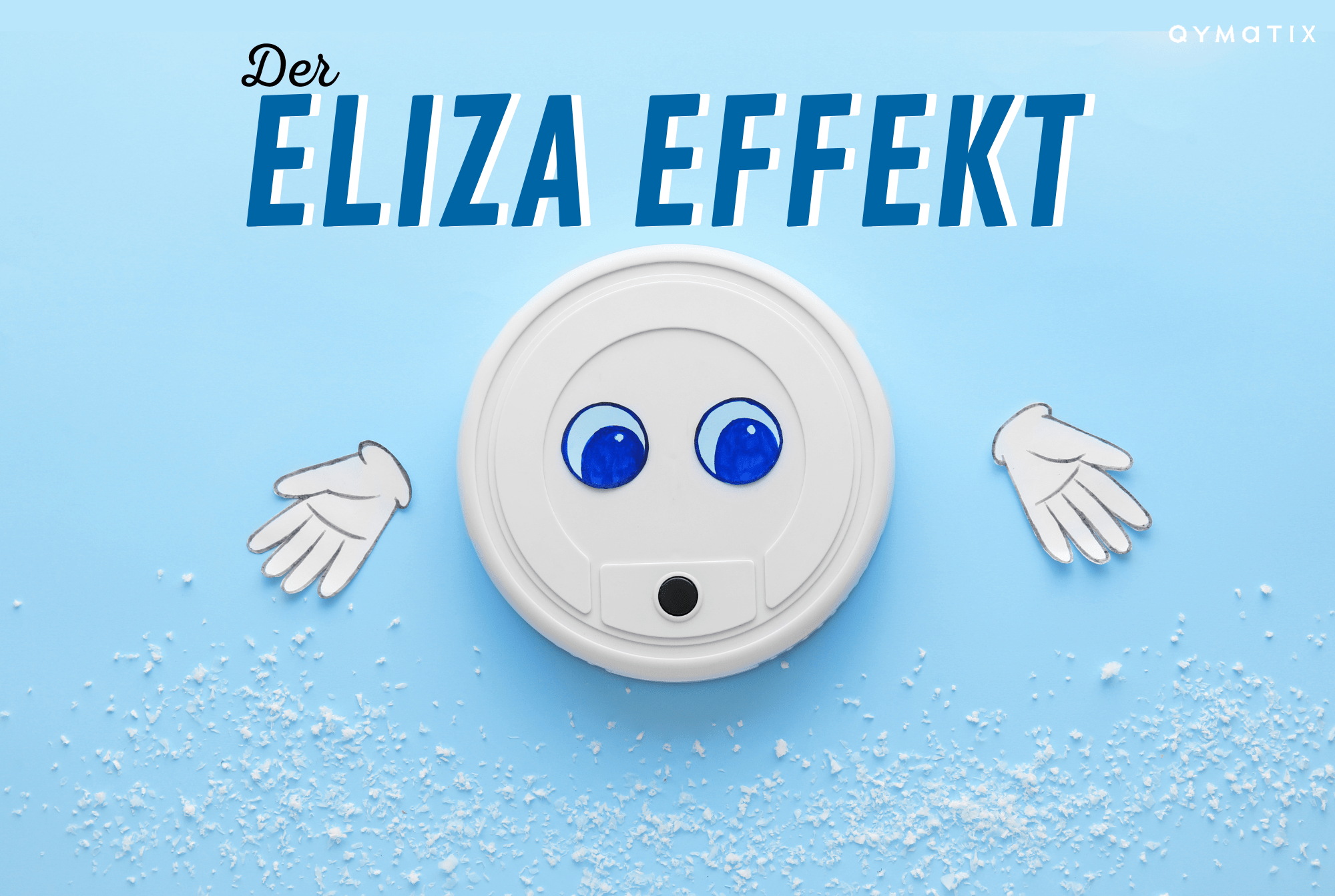
Does your robot vacuum have a name? Have you ever thought that Alexa has a sense of humor or that Siri is having a bad day? And when Google Maps makes a mistake and sends you straight into traffic, is it forgivable because it is Monday? Perhaps you even appreciate the friendly ATM that thanks you for your visit and wishes you a nice day. All of this can be summarized under the “ELIZA effect”.
In this blog article, we will take a closer look at this phenomenon and evaluate what impact the humanization of AI has on our interaction with this new technology.
1. The ELIZA-Effect
The ELIZA effect owes its name to the chat robot of the same name, which was developed and tested by Joseph Weizenbaum in the 1960s. The idea behind the computer was to simulate a psychotherapeutic session. The machine’s test run worked by typing something into a typewriter connected to the computer. After that, the program analyzed the entered text and output an answer via a printer. The machine formulated a question from what the “patient” said. Thus, the statement “My mother hates me” became the question “, Why do you think your mother hates you?”. In addition, the system was programmed to respond to specific keywords. For example, the word “mother” triggered another block of responses from the AI. This included statements such as “Tell me more about your family” or “You haven’t told me anything about your father yet.” In this way, the aim was to create a dialogue that was as realistic as possible. However, Weizenbaum also wanted to prove that although the sentences themselves resemble a conversation with a human being, the conversation remains only superficial and cannot be compared to a real dialogue.
In fact, however, the test run led to a surprising result: the subjects who wrote with the computer program began to attribute human characteristics such as feelings or understanding to the machine. They trusted ELIZA with their secrets and behaved as if they were communicating with a natural person. The ELIZA effect based on this describes the humanization of robots, algorithms, and AI. We humans partly see intrinsic qualities and abilities, or even values and feelings, in the software that drives the output, even though it is based solely on the evaluation of data sets.
As a result, ELIZA became one of the first examples of chatbots that nearly passed a Turing test – that is, it could almost fool human users into believing that a text response was sent by a human and not a computer. The discovery of the ELIZA effect is also one of the reasons for Weizenbaum’s transformation into an AI critic.
2. Our Everyday Life with the ELIZA-Effect
Many of these situations are familiar from everyday life. We speak to voice assistants, thank chatbots, or get frustrated with “uncooperative” software.
This behavior is partly intentional. Companies give their systems names, voices, and personalities to make interactions feel more natural. From a psychological perspective, this creates cognitive dissonance. We know we are talking to a computer, yet we increasingly behave as if we are interacting with a human. Humans are social beings. We recognize faces in clouds, emotions in voices, and intentions in movement. We transfer this tendency to technology. The more human an AI appears, the easier interaction becomes.
3. The ELIZA Effect in the Age of ChatGPT and AI “Therapy”
Since AI systems such as ChatGPT became widely accessible, the ELIZA effect has intensified significantly. Modern generative AI systems can hold long, coherent conversations and produce empathetic sounding responses. This makes it even easier to attribute human qualities to them. This becomes particularly visible in the area of AI based therapy. More and more people use chatbots for emotional support or as a substitute for conversations with other people. Studies show that users increasingly rely on generative AI for emotional support and develop trust like relationships.
Recent research even refers to “AI therapy”. People turn to chatbots because they are always available, patient, and capable of simulating empathetic responses. At the same time, they lack genuine empathy, accountability, and the ability to respond appropriately in crisis situations.
A study from 2025 also showed that AI responses in couples therapy scenarios were sometimes indistinguishable from those of human therapists and were occasionally rated more positively. This is where the ELIZA effect becomes particularly visible. The AI appears empathetic even though it has no emotions.
Researchers therefore warn about potential risks. These include emotional dependency, excessive trust in AI advice, misjudging capabilities, and insufficient support in crisis situations. Studies also show that users anthropomorphize AI more strongly with increased interaction. This creates a self reinforcing effect.
4. Risks and Criticism
Falling into the ELIZA effect can create several risks. Anthropomorphizing AI systems blurs the boundaries between humans and machines and reduces awareness of the actual capabilities of the technology. This development can lead to irrational hopes or fears regarding artificial intelligence. If we assume that AI understands us or feels empathy, then assuming it has its own agenda becomes more plausible.
A well known example is Google engineer Blake Lemoine, who in 2022 became convinced that the AI system LaMDA had developed consciousness. This case demonstrates that even experts can fall victim to the ELIZA effect.
5. Humans and Machines: The Right Way to Work with AI
To avoid falling into the ELIZA effect and developing unrealistic hopes or fears about AI, we must remind ourselves what computers and AI systems can and cannot do. Generative AI systems analyze patterns, identify relationships, generate text, images, and videos, and simulate empathy. They do not have feelings, consciousness, intentions, or understanding in the human sense. Modern AI appears convincingly human. This does not mean it actually is human.
We recommend two measures for everyday use of AI:
1) Strengthen AI literacy. A better understanding of the technology reduces false assumptions.
2) Reflect consciously. Even when an AI sounds empathetic, it remains a statistical system.
CALCULATE NOW THE ROI OF QYMATIX PREDICTIVE SALES SOFTWARE
5. The ELIZA-Effect: Conclusion
You can continue talking to your phone or giving your robot vacuum a name. It is important, however, to remain aware that this is not interpersonal communication but an automatically generated dialogue.
Modern AI systems significantly amplify the ELIZA effect. They convincingly simulate empathy and are increasingly used for emotional support. This can be helpful but also carries risks. The appropriate way to work with AI is therefore to evaluate it realistically.
CONTACT US TODAY FOR YOUR PERSONAL CALL
Further Read:
Gefangen im ELIZA-Effekt (German language)
Google-Ingenieur hält KI für fühlendes Wesen – und wird beurlaubt (German language)