


From Excel Chaos to Data Driven Pricing: How Wholesalers Increase Margins by 12 % with ERP Analytics

Please enter your Email address
The Excel Pricing Dilemma in B2B Wholesale
You open the same Excel spreadsheet you have been using for years. Automotive customers receive a 6% discount, A-customers 8%. Electrical contractors without warehouses, but who enjoy stopping by for coffee: 10%. Skilled tradespeople automatically receive a 2% discount, while the system integrator in building technology is officially classified as “unclassified” and still receives a 5% discount.
The rules are simple and the logic seems clear: standardized discounts for standardized customer groups.
Why? Because this is how it has always been done. Excel simplifies complexity. Your business becomes more complex every year. What worked in the past is now becoming a risk. Behind these rules are assumptions that no longer reflect reality. Customers have changed. Markets have become more volatile. Purchasing prices fluctuate faster than ever before. Somewhere in your spreadsheet there is a customer who has been buying too cheaply for months. And another customer who would be willing to pay more, but was never asked.
The logic appears clear. Reality is not.
Five years ago, this system still worked reasonably well. Markets were more stable, prices were more predictable, and customers accepted the rules of the game. Today, however, your profit and loss statement tells a different story: this Excel based pricing policy is slowly but steadily pushing you toward lower profitability.
Purchase prices are rising, customers expect individualization, and competitors are already using data to make smarter decisions. While you are still struggling with manual price lists, you are not only losing margin, but also customers, often without even realizing it.
Why Excel Pricing Strategies in Wholesale Are Systematically Failing Today
Technical wholesale is changing quietly, but fundamentally.
Growing complexity, increasing margin pressure, and digital procurement are changing customer buying behavior. At the same time, many companies still rely on what was once a sensible Excel pricing model that no longer reflects market reality.
At first glance, your pricing table may appear structured. See the example below. There are discounts for industries, customer types, ABC classifications, product groups, and quantities. In practice, these discounts are simply added together without questioning whether the result is economically reasonable. What appears to be a systematic approach is actually based on historical assumptions that are long outdated.
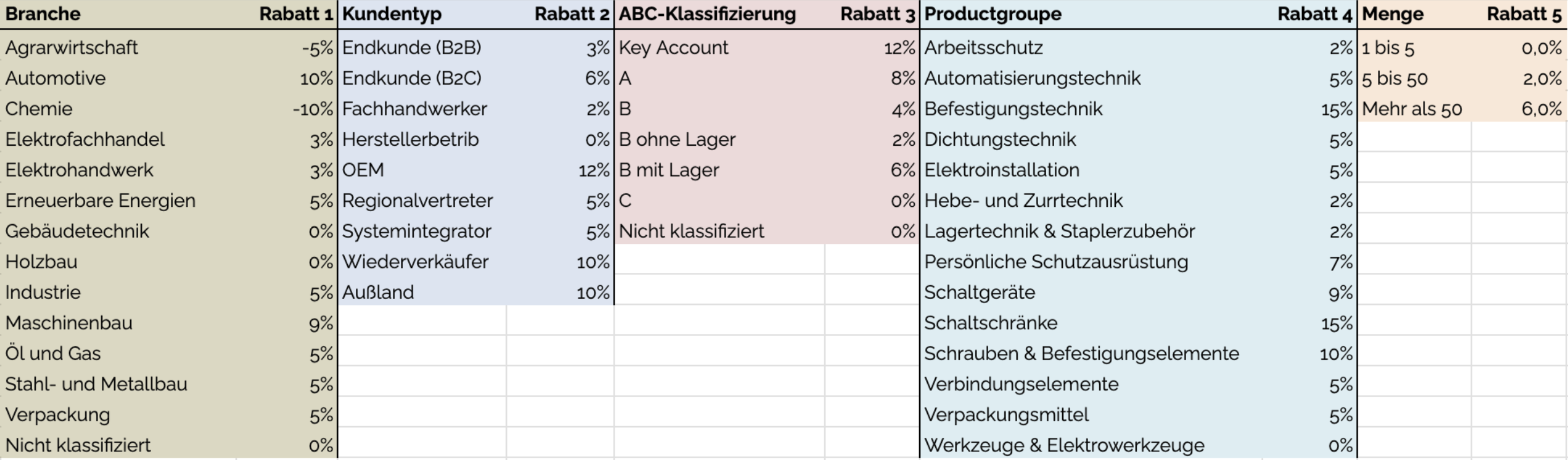
Looks familiar, doesn’t it? What is it called in your company? This pricing policy may appear structured, but today it is often little more than a historical compromise. How could it realistically be otherwise? How many customers do you manage across how many products? As if your trainees had the time to carefully calculate every quotation manually.
And what is the real problem? Adding discounts together does not reflect actual price acceptance. A customer product combination accumulates discounts across multiple dimensions regardless of market reality. By the end of the day, whether over the phone, at the sales counter, or on a construction site, everyone gives away whatever they think is necessary as long as the customer buys something. Goodbye EBIT.
At the same time, there is no connection to actual customer behavior. Whether a customer would accept higher prices, whether they are growing, or whether they are close to switching to a competitor remains completely ignored. Your pricing calculation does not react to current market dynamics, but instead relies on outdated categories. As a result, margin is lost even though your ERP data could already show exactly where pricing opportunities exist.
More Data, More Problems: Why Complex Price Lists and External Pricing Data Lead You Astray
There are two ideas we hear repeatedly: more details or more data. Expanding the old discount table with “more details” or extracting external pricing data may sound tempting. In reality, both approaches make the problem worse. More columns in Excel create more complexity instead of clarity. Every additional rule increases the lack of transparency. Eventually, nobody knows why one customer receives a 7 % discount while another receives 12 %.
And what about external pricing data? It may show what others are charging, but not what your customers are actually willing to pay. If you do not have a standardized European coding system that clearly identifies products and SKUs, the effort required increases significantly. It is not only expensive, but often irrelevant.
The real lever is not more data, but using the right models with your own ERP data. Companies that rely on the vague feeling that “this might be interesting” lose control over what truly matters: data driven decisions that protect margins.
The most critical problem, however, is that Excel based pricing systems are no longer scalable and barely sustainable. Every new rule increases complexity and deepens the lack of transparency. Eventually, nobody understands why a customer receives a specific price. Adding discounts together may seem simple, but it is one of the most inefficient ways to manage pricing decisions in wholesale. The reasons behind it are understandable, but under today’s market conditions these systems are increasingly reaching their limits.
Excel feels like control. In reality, it is often a well organized blind flight.
The Data Driven Alternative: How AI Is Transforming Your Discount Strategy
Imagine being able to identify the optimal price for every customer, every product variation in your portfolio, and every order quantity. Not based on rigid rules, but on your own ERP data. No more blanket discounts, no more manual Excel updates, but clear, data driven recommendations that protect your margins while strengthening customer relationships.

This is exactly the approach we use at Qymatix. Instead of relying on outdated discount tables, we use your historical, current, and accepted prices to calculate the most likely price range using AI algorithms. No fixed rules, but continuously learning models that become more precise with every transaction. The result? Data driven pricing not only improves margins, but also increases customer loyalty.
From Fixed Prices to Dynamic Price Recommendations
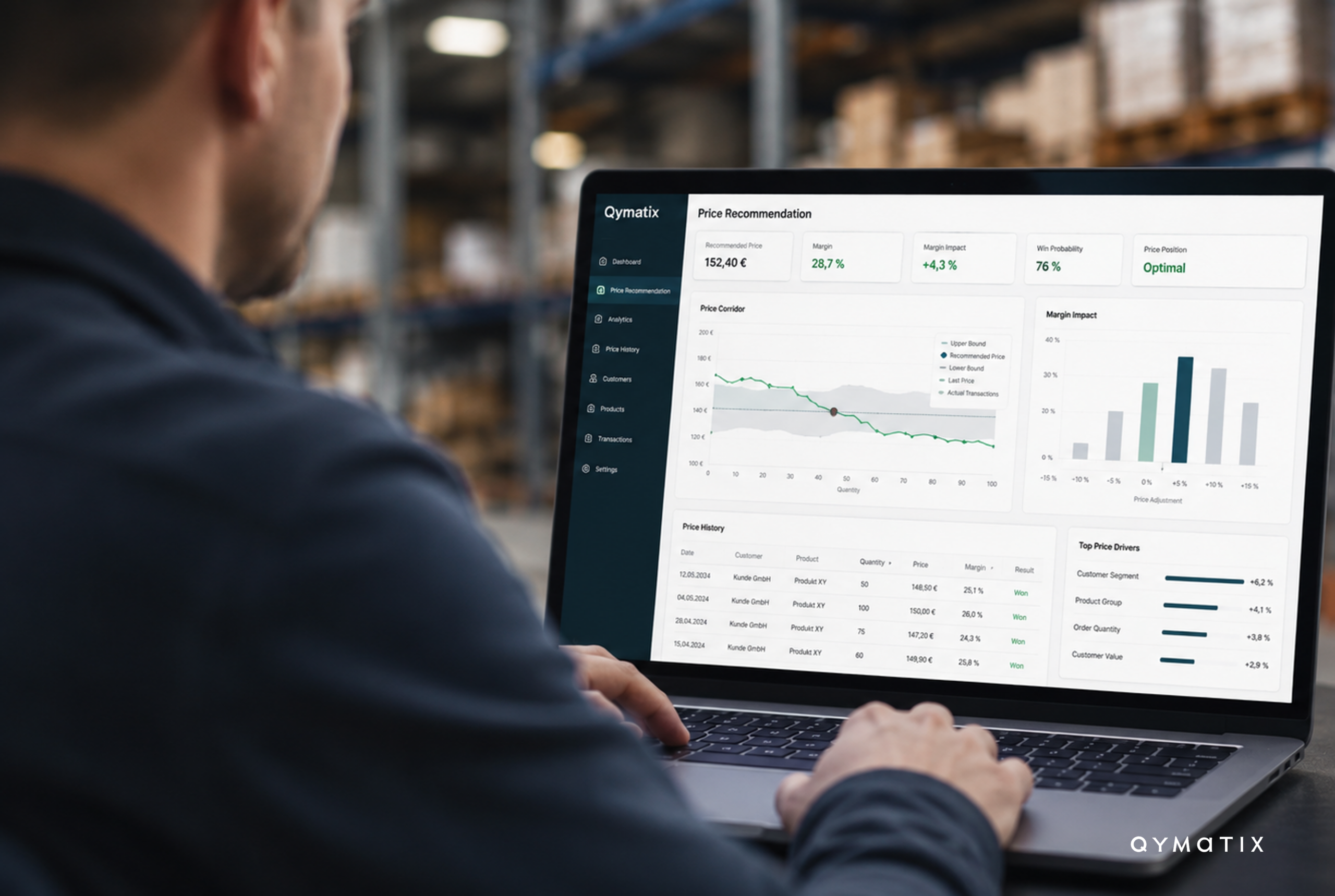
In practice, this means you no longer see one fixed price, but an AI generated price corridor. For every customer, every product, and every order quantity, the system calculates a lower and upper value. It then recommends the price with the highest probability of acceptance. No arbitrary discount additions, no gut feeling decisions, but a clear data driven recommendation derived directly from your ERP data.
The logic behind it is simple, but the calculations are complex. Instead of adding discounts together, the system analyzes millions of historical purchasing decisions: Who bought what, when, and at what price? How did purchasing behavior evolve afterward? The result is not a rigid price recommendation, but a probability. And that probability determines whether you realize margin or give it away.
The key difference compared to an Excel spreadsheet is that this model continuously adapts. Have purchase prices changed? Has customer behavior shifted? Are order quantities fluctuating? The recommended price corridor updates automatically. Your sales team no longer has to spend hours debating whether a price is “fair.” Instead, they immediately see the range in which they can operate and receive a clear assessment of what the customer is likely to accept.
A Real World Example: 12 % Higher Margins Without New Price Lists
A technical wholesaler with around 8,000 customers implemented this approach without months of IT projects, without new price lists, and without additional training. The company simply used its existing ERP data and increased margins by 12 % within six months while maintaining customer satisfaction at 95 %.
How? By reducing blanket discounts and improving price acceptance among key customers. Not through pressure, but through better decisions at the right moment. Sales teams no longer had to guess which prices would work. They received clear, data driven recommendations directly from the system.
What does this mean for the annual balance sheet? With annual revenue of €100 million and a typical margin of 5 %, a 12 % margin improvement corresponds to an additional €600,000 in margin per year. And this comes without additional revenue and without acquiring new customers, but purely through smarter pricing decisions. This is not a theoretical scenario. It is the result of precise data analysis uncovering existing potential.
It Is Not About Tools. It Is About Better Decisions.
Many discussions about digital transformation focus entirely on which sales software is best. Do we need a completely new CRM? Which platform is easiest to integrate? Which tool offers the most features? But these questions miss the point.
The real difference lies in day to day decision making. It means moving away from static, rule based pricing and toward dynamic, data driven probabilities. It means enabling sales teams to make decisions that are not only faster, but also better, calmer, and more confident.
The question is not whether you can afford it. The real question is: how much longer can you afford not to do it?
Two Critical Questions for Your Wholesale Business
1. Do you know which 20 % of your customers cause 80 % of your discount related problems?
(The answer is already in your ERP data. You simply need to make it visible.)
2. Do you know which customers you are leaving margin on today, even though they would be willing to pay more?
(The answer is already in your system. You just need the right analysis.)
CALCULATE NOW THE ROI OF QYMATIX PREDICTIVE SALES SOFTWARE
Conclusion: The Future of Pricing Lies in Your Data
Your Excel spreadsheet was once a useful tool. That time is over. Today, it has become a serious obstacle. Markets are too dynamic, customers too demanding, and competitors too data driven for companies to continue relying on manual price lists.
The good news is this: you do not need to become a technology company in order to implement data driven pricing. You do not need expensive AI specialists, months of IT projects, or completely new systems. You only need the data already hidden inside your ERP system and the right questions to unlock its value.
The decision is yours:
• Continue as before, with shrinking margins, dissatisfied customers, and a sales organization drowning in Excel chaos.
• Or take the next step toward a pricing strategy based not on rigid rules, but on probabilities. Toward decisions guided not by gut feeling, but by your own data.
Talk to us about the two or three concrete decisions that could noticeably improve your margins over the next six months. No hype. No buzzwords. Just better data and better results.