


Profitability in Wholesale: Why AI Makes the Difference Now


Please enter your Email address
Do you like numbers? I do. Numbers can explain a lot. Numbers can create understanding. But they only reflect reality to a limited extent. Still, I would like to use an example to illustrate why you should start using predictive analytics in sales and AI in B2B sales now.
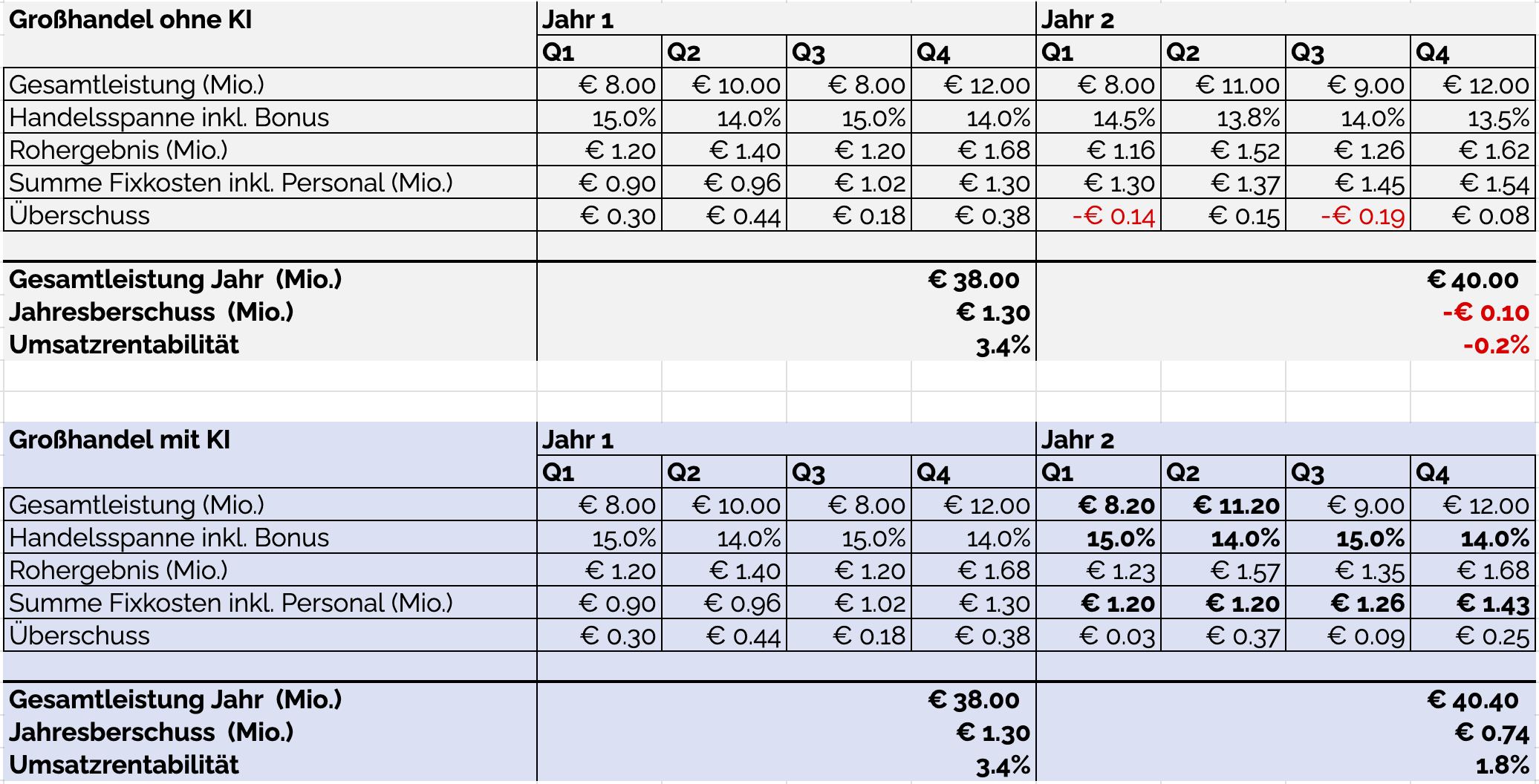
Let’s look at a practical example together. The image below shows two years from two wholesalers of the same size—one uses AI, the other does not. What does that mean for their survival?
The Excel table compares the quarterly figures of two B2B wholesalers, one with and one without the use of artificial intelligence in B2B sales, over two fiscal years. It includes key performance indicators such as:
• Total performance (in million €) – i.e., quarterly revenue
• Trading margin incl. bonuses – i.e., margin including rebates
• Gross profit (in million €) – i.e., total gross earnings
• Fixed costs incl. personnel – i.e., fixed operating expenses including personnel costs
• Annual surplus (in million €) – i.e., annual operating profit
• Profitability (profit/revenue), shown additionally for the full year
You will probably find similar figures in your own annual report. I know that my example may not match your situation exactly, but with around 40 million euros in revenue and a trading margin between 15 and 20 percent, it might reflect the reality of most family-run medium-sized wholesalers in Germany. These are just two simple examples. They are based on real cases from companies we work with every day, which are of course anonymized and slightly adjusted.
In the world of future of B2B wholesale, there is one constant: change. Yet some myths persist. One of them goes: “We don’t need AI, we’ve always done it this way.”
My example is an exaggerated simplification meant to open your eyes to why it is now essential to start working with AI-driven decision-making. My Excel example is very simple, very real, and hopefully very interesting.
Can wholesalers increase their profits with AI software in sales?
“We don’t need AI, we’ve always done it this way,” or “We’ve been using AI for months and hardly notice any change.” Really? Anyone still thinking like that should take a look at the profitability table I’m sharing here. Two wholesale companies, same industry, similar starting position. The difference? One uses AI in sales, the other does not. The result? A story every sales leader should know. Let’s look at these two examples over a period of two years.
Year 1 – Solid starting position
In the first year, the picture looks stable.
Revenue increases from Q1 (€8 million) to Q4 (€12 million).
The trading margin remains constant between 14 % and 15 %.
Fixed costs rise moderately with revenue.
A positive surplus is achieved in all quarters.
The annual profitability is around 3.4 %.
In short: a classic wholesale business with a solid foundation but little strategic control.
Year 2 – The break in stability
In the second year, the picture changes quickly—despite similar revenue levels.
Individual quarters (e.g., Q2 and Q4 with €11 million and €12 million) remain strong.
The trading margin decreases slightly from 14.5% to 13.5% over the year—an indication of weak price enforcement.
Fixed costs rise due to inflation, labor shortages, and more expensive logistics: from €1.3 million in Q1 to €1.54 million in Q4.
Losses are recorded in two quarters (Q1 and Q3).
The annual report shows a negative profitability of -0.25%. Boom! Money gone.
It becomes clear that the company has deteriorated operationally—not due to lack of sales, but due to poor steering. Without data-based prioritization, too many resources were spent on unprofitable customers and orders. Prices were not adjusted enough, and opportunities went unnoticed.
And keep in mind, I’m not talking about using a Large Language Model (LLM) to chat with your data—no. I’m explaining why integrating operational sales forecasts into your sales process removes some of the friction that will otherwise cost you dearly over the next two years.
Profitability in B2B wholesale – the bitter truth
The company without AI started off solidly. No reason to worry, “keep going, AI will fade away anyway.” In the first year, total quarterly performance was between 8 and 12 million euros. Not bad. But looking closer, the real problem becomes visible: profitability in the second year dropped to -0.25%. That’s not just a warning sign. It’s a wake-up call for wholesale. Despite rising sales in some quarters, the surplus turned negative in the second year. And all that with only minor changes to the underlying assumptions. For many companies of this size, this is the harsh reality.
And I assume your revenue will remain roughly stable. In 2024, that was not the case for most medium-sized wholesalers. A revenue decline of – say – 5% would be disastrous.
And now comes the bitter truth: the first company did not sell too little. It sold wrong. Without data-driven steering, too many resources went to unprofitable customers, prices remained rigid, margins were too low. Costs rose anyway. What does a salesperson in wholesale do? They are supposed to advise, identify opportunities, and spark demand. But how can they do that when they have to prioritize 1,000 customers based on who shouts the loudest? How could they do it better, if they don’t know who has potential and who is at risk?
This is where predictive sales analytics comes in. Not as a buzzword, but as a strategic sales tool. Not to double revenue or replace all sales staff, no. But to proactively increase the chances of selling more every day, at better prices, to more customers, with the same limited resources in sales. All in small steps, day by day.
Take another look at my example. The second company sells slightly more in just two quarters, at slightly better prices and nearly identical costs. This company introduced AI to optimize its sales processes. Predictive analytics for cross-selling. Automated price suggestions. Churn warning systems. The result was a stable surplus, significantly higher efficiency, and a profitability rate worth mentioning. And that’s not science fiction.
AI in B2B wholesale – a recipe for success
Success is the new normal in modern, data-driven wholesale. Anyone running a purchasing or assortment-based wholesale business today must be capable of more than just moving products. It’s about intelligence—about digital support that turns data into decisions. Because when 50,000 products need to be sold, gut feeling is no longer enough. Only AI can do that.
I talk to sales leaders every day who are under enormous pressure. 5,000 to 10,000 customers, 100,000 products, rising expectations, tight margins. Anyone who cannot prioritize will lose. This is where AI shows its full potential: it helps to recognize patterns, avoid risks, and seize opportunities. The companies that understand this today will be ahead in two years. Not because they hire more people, meaning higher costs, but because their sales teams work smarter.
Profitability is the one key figure that tells the whole story. It shows whether a company not only sells but also earns. And it’s measurable. So, anyone wondering whether AI is worth it doesn’t need consultants—just a look at their numbers. Those who want to protect their margins today must manage their processes based on data. No ifs or buts.
CALCULATE NOW THE ROI OF QYMATIX PREDICTIVE SALES SOFTWARE
Improving profitability in wholesale with AI now
Conclusion: Contrary to popular belief, wholesale will not disappear. But it will reinvent itself. Companies that ignore AI will be overtaken by those who act. Those who want to safeguard revenue and profit for the future need systems that think along. Not gut feeling, but prioritization. Not blind action, but targeted steering. That’s why now is the time to deal with AI in sales. Not tomorrow. Today.
If you want to know what this looks like in practice, talk to us. Because those who ask, win.